Why a Low Ceiling Changes the Shape of a Scene
Low-ceiling theatre changes blocking, sound and visual scale. Shape a village-hall scene around intimate audience distance, clear speech and practical movement.
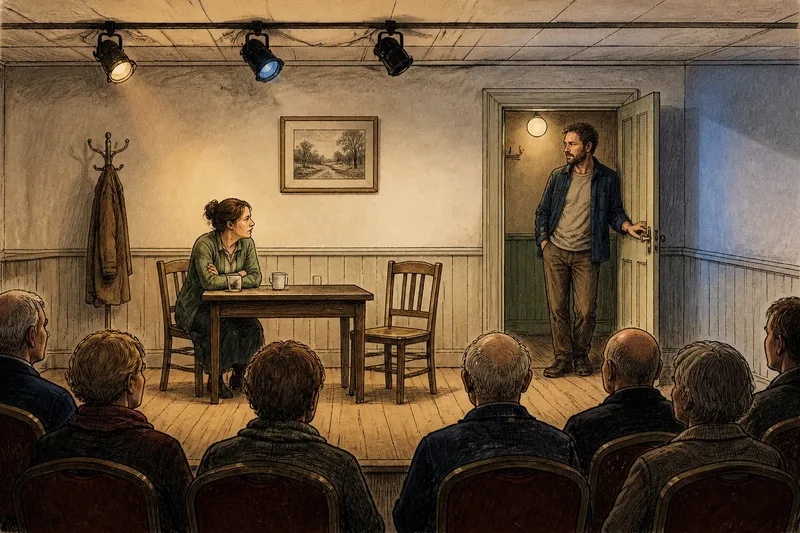
A low ceiling theatre rewards compact choices. In a village hall, actors may stand close to the front row while lights, scenery and sound share a shallow space. Low-ceiling theatre works best when its staging draws on that closeness instead of trying to imitate a grand auditorium.
How does a low ceiling change the audience’s experience?
In a modest room, a quiet exchange can feel immediate because the audience is near enough to notice a glance or a held breath. That intimacy also makes broad gestures, tall scenery and forceful delivery more conspicuous. The aim is not to make every action smaller. It is to choose actions that suit the room’s proportions.
Think about the emotional scale of a scene. A dispute might feel sharper when two people share a table, while a character waiting alone can seem isolated across a bare stretch of floor. Let the relationship between actors carry the scene rather than asking scenery to supply grandeur.
How can actors make movement feel dynamic?
Vary pace, direction and attention instead of relying on height. An actor can cross behind a table, stop at a doorway or turn away at the moment a difficult question lands. A pause can change the rhythm just as clearly as a quick crossing.
Keep movement motivated. If a character shifts position, give the audience a reason to follow: a new person has arrived, a private thought has changed the conversation, or a prop has become important. A small action reads clearly when it changes the scene’s focus.
For tension between characters of different status, a change in distance may be more useful than a platform. One person might remain seated while the other approaches and stops nearby. Their contrasting positions can suggest an imbalance without sending anyone toward a low beam.
How should speech and silence work in a village hall?
Nearby listeners can hear detail that would disappear in a larger auditorium, so actors may not need to push every line. Encourage clear, supported speech and crisp consonants without turning conversation into a declaration. A useful pause gives the audience time to register a reaction; a pause held too long may expose background noise.
Listen from several parts of the room during an ordinary run-through. A portable speaker or microphone may help if words are difficult to follow, but amplification can change the relationship between a speaker and the person onstage. If you use a sound system, check it in the venue and aim for speech that still feels attached to the actor.
Notice the room’s regular sounds: a heating system, a corridor door or chairs on a hard floor. If a particular moment depends on a whisper, consider moving it away from a likely interruption or making the essential information audible in the dialogue.
What can replace tall scenery?
Use a few objects that help actors establish relationships. A table can suggest a meeting place or a barrier; a coat stand can give someone a reason to pause; a doorway can shape an entrance. The object matters because of what the actors do with it, not because it fills empty space.
Imagine a village-hall group staging a family argument with a table, two chairs and a doorway. The director wants the last line to feel like a break between relatives, so one actor leaves a chair empty and speaks from the doorway rather than crossing the room. The expected result is a visible change in their connection, created with the existing furniture and no taller set.
Lighting can focus attention without adding scenery overhead. A change in brightness or colour may mark a shift in mood, provided the equipment is arranged safely and follows the venue’s rules. Use qualified help for rigging or electrical work, and ask the venue about restrictions before bringing in equipment.
What should you check before settling the staging?
Should actors face the audience all the time?
No. Let them respond naturally to each other, but adjust their angle when a scene depends on facial expression or a quiet line.
Does a low ceiling rule out platforms?
No, but a platform may create awkward overhead clearance or make movement feel compressed. Consider one only if it serves the performance and fits the venue’s safety requirements.
How can you tell whether dialogue is clear?
Ask a listener in a distant seat to describe the exchange after an ordinary run-through. If essential words are missed, try clearer articulation or a change in pacing before increasing volume.
Can a small venue still support a dramatic entrance?
Yes. A brief pause beyond a doorway, a sudden shift in attention or an entrance into an already-lit area can build anticipation without a tall arch or elaborate scenery.
How do you adapt a scene to the room?
Run the scene with its intended furniture, lighting and sound. Watch how the pace changes when actors cross, handle props or leave a silence. If one moment feels crowded or hard to follow, change a single staging choice and run it again; that makes the effect of the adjustment easier to judge.
Before the audience arrives, confirm that temporary staging and technical equipment follow the venue’s instructions. For questions about structural support, rigging or electrical work, consult a qualified professional. A low-ceiling theatre can make a scene feel close and alive when its movement, pauses and speech are shaped for the room rather than stretched to fill it.