Before the Prompt Book: How Rehearsal Choices Were Remembered
Rehearsal notes turn passing choices into a shared record, helping village-hall performers recover cues, blocking and agreed changes without relying on memory.
Rehearsal notes turn a passing choice into something the whole company can recover. In a village-hall production, that record might begin as a pencil mark in one actor’s script and end as a shared prompt book that keeps entrances, cues and agreed changes clear when the cast cannot all be in the room.
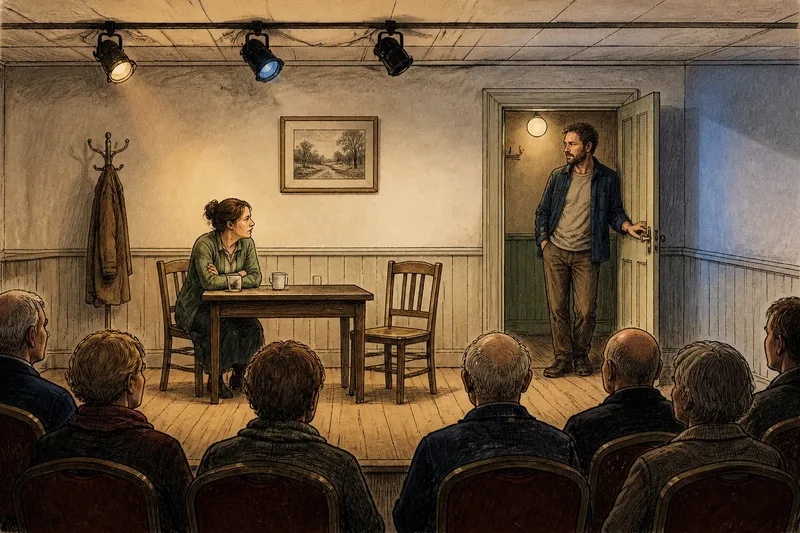
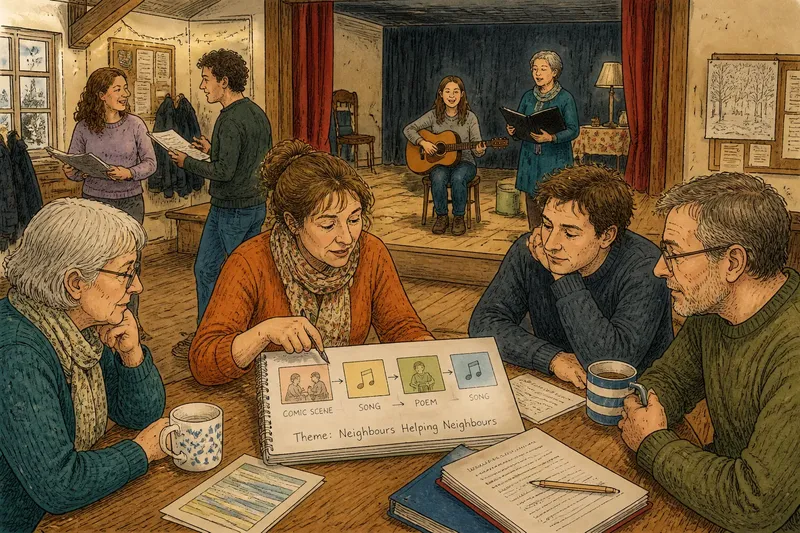
Imagine the invented Brookfield Players are preparing a comedy in a borrowed hall. Their director, Mara, has rehearsals on different evenings, two actors who work shifts, and a scene whose timing depends on a chair being moved before a line. At the first run-through, the company settles the moment by trying several versions. The practical question is not only what works, but how to remember the decision without turning every script into a maze of private marks.
What should the company remember?
At the start, the group treats every note as equally important. One actor writes a new entrance in the margin. Another records that a line should be quieter. Mara notes a pause, a chair move and a cue for a sound effect. By the next rehearsal, their pages hold a jumble of decisions, suggestions and abandoned experiments.
The group sorts the material into three useful kinds:
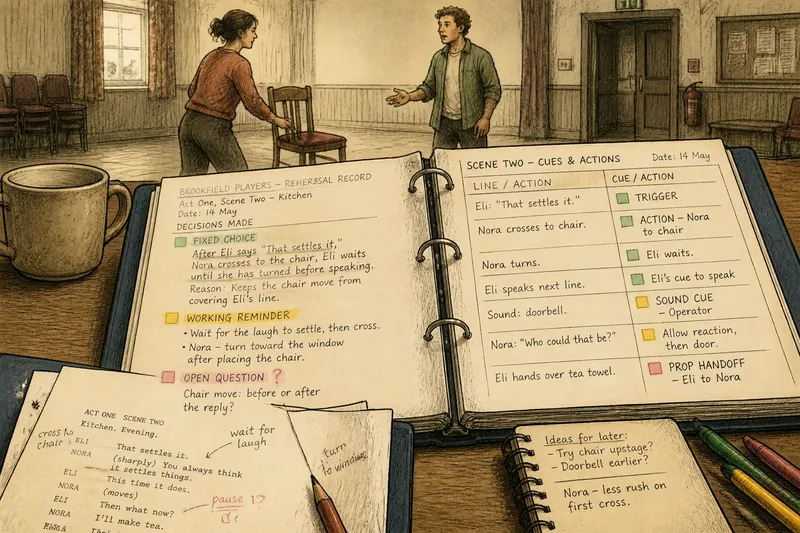
- Fixed choices: decisions the director and performers have agreed to keep, such as where a scene begins or which entrance a character uses.
- Working reminders: prompts that help someone rehearse, such as “wait for the laugh” or “turn toward the window.”
- Open questions: ideas still being tried, such as whether the chair move belongs before or after a particular line.
This distinction matters because an early suggestion can look official once it has been written down. Mara asks the group to mark open questions with a small question mark and leave fixed choices in a different color. The actors can still make personal notes, but those notes no longer quietly become company policy.
They also agree to record only decisions that affect another person or the shape of the scene. A private reminder about one actor’s line emphasis can stay in that actor’s script. A change to an entrance, shared prop, sound cue or handoff belongs in the common record. That simple boundary keeps the record useful rather than exhaustive.
How did the first notes become a shared document?
Mara begins with a loose-leaf binder kept at the hall. Its pages include the cast list, a scene-by-scene cue record and a section for decisions made during rehearsal. She gives each page a date and a short description, such as “Act one, kitchen scene: chair move.” The binder is easy to open during rehearsal and does not depend on every performer having the same device.
The actors’ scripts remain personal working copies. They can underline lines, add character thoughts or jot down a physical reminder without asking the rest of the group to adopt it. When a note changes shared movement, the actor brings it to Mara. If the company agrees, Mara transfers the decision to the binder and the actors update their copies as needed.
For the chair moment, the first agreed note reads: “After Eli says ‘That settles it,’ Nora crosses to the chair; Eli waits until she has turned before speaking.” It records the trigger, the action and the next cue. It does not prescribe every gesture or expression. The performers retain room to play the scene while sharing the timing that makes it work.
To avoid a string of contradictory notes, Mara dates revisions and crosses out superseded wording with a single line rather than erasing it. The earlier version remains legible, but the current choice is easy to spot. She adds a brief reason only when it helps explain the decision: “Keeps the chair move from covering Eli’s line.” That note will be useful if the timing drifts later.
What changed when an actor missed rehearsal?
In the invented scenario, Nora’s actor misses an evening shift. At the next rehearsal, she has her marked script, but the company has also changed a sound cue and adjusted the chair move. The binder tells her the agreed order. It does not pretend she has absorbed the rhythm by reading a sentence.
Mara walks the moment with her, while Eli’s actor gives the lines and the stage manager handles the sound cue. Nora can ask why the chair move sits where it does, then try it at performance pace. The shared record restores the decision; a brief rehearsal restores the feel of it. Keeping those jobs distinct prevents a written note from being treated as a substitute for practice.
The group also discovers a small weakness in its record. “After the line” seemed clear to everyone who had been present, but Nora does not know whether it means after the final word, after the response, or after the audience reaction. They revise the note to name the exact spoken cue. Where timing depends on an audience response, they write a flexible instruction such as “allow the laugh to settle, then cross.”
That adjustment is not an invitation to script every pause. It shows why a note should be precise about the shared trigger and flexible about what cannot be timed in advance. A touring act or amateur company playing to different rooms may need to let a laugh, silence or entrance settle at a different pace from night to night.
Which rehearsal notes belong in the prompt book?
As the production settles, Mara transfers the durable material into a prompt book: the current script, entrances and exits, agreed blocking that affects others, cue points, prop handoffs and changes the company has approved. In a small group, the binder can serve as the prompt book. A larger company may keep a separate copy with the person calling cues.
Not every creative conversation belongs there. An actor’s private interpretation, a discarded staging idea and a temporary experiment do not need permanent space. If the company is still deciding, the prompt book should say so plainly rather than present a provisional choice as settled. This keeps the record honest and makes later review less confusing.
For Brookfield Players, the sound cue is written beside the line that triggers it, with the cue operator’s action described in plain language. The chair move is recorded in the scene’s blocking notes. A prop handoff receives its own entry because another performer depends on it. Those details are more useful than a page of vague reminders such as “be quicker” or “make the scene flow.”
When a performance changes the timing, the person responsible for the record can note the adjustment after the show and confirm it at the next call. A spontaneous variation should not be copied into the master record just because it happened once. The company first decides whether it wants to repeat the change.
How can rehearsal notes stay useful over time?
The group settles on a small routine. At the end of each rehearsal, Mara reads back the new fixed choices, asks whether any open questions remain, and updates the binder before it leaves the hall. At the next call, the company checks only changes that affect the work being rehearsed. The goal is a dependable record, not a ceremony around paperwork.
- Write the cue that starts an action, not only the action itself.
- Identify who moves a shared prop and who receives it.
- Mark whether a note is fixed, personal or still under discussion.
- Date meaningful changes and keep the current wording easy to locate.
- Use plain terms that a performer who missed rehearsal can understand.
- Read an important note aloud and walk it once with the people it affects.
Say the invented company later decides Nora should move the chair before Eli’s last line, not after it. Mara updates the scene note, tells the sound operator that the cue remains unchanged, and has the two actors run the new sequence. The observable result is a common version: both performers know when the movement begins, the operator knows the cue still follows the same line, and a late-arriving cast member can see which wording replaced the old one.
That example also shows why the record should name only the relationships that matter. If every breath, glance and step becomes fixed, the document can make a scene feel brittle and overwhelm the people trying to use it. If nothing is written, a change that one performer remembers may surprise everyone else. The useful middle ground is to record what another person needs in order to repeat, support or call the choice.
What does the shared record leave to performers?
A prompt book is a memory aid, not a performance. It can preserve an agreed cue or show how a scene’s traffic was arranged, but it cannot carry the attention between two actors, the pace of a live audience or the small adjustments that keep a moment responsive. Those remain part of rehearsal and performance.
In the Brookfield Players’ invented case, the binder gives the company a common account of its decisions, while each actor’s script still reflects personal work. When a new question arises, the group can distinguish it from the choices already made. When someone misses rehearsal, they have a place to begin, then can reconnect with the scene by playing it.
For a small rural company, the best record is often the one that survives an ordinary evening: a clear page in a shared binder, a dated change, and wording another performer can understand without guessing. Before the prompt book becomes the authority, the company must decide what deserves to be remembered together—and what should stay alive in the room.